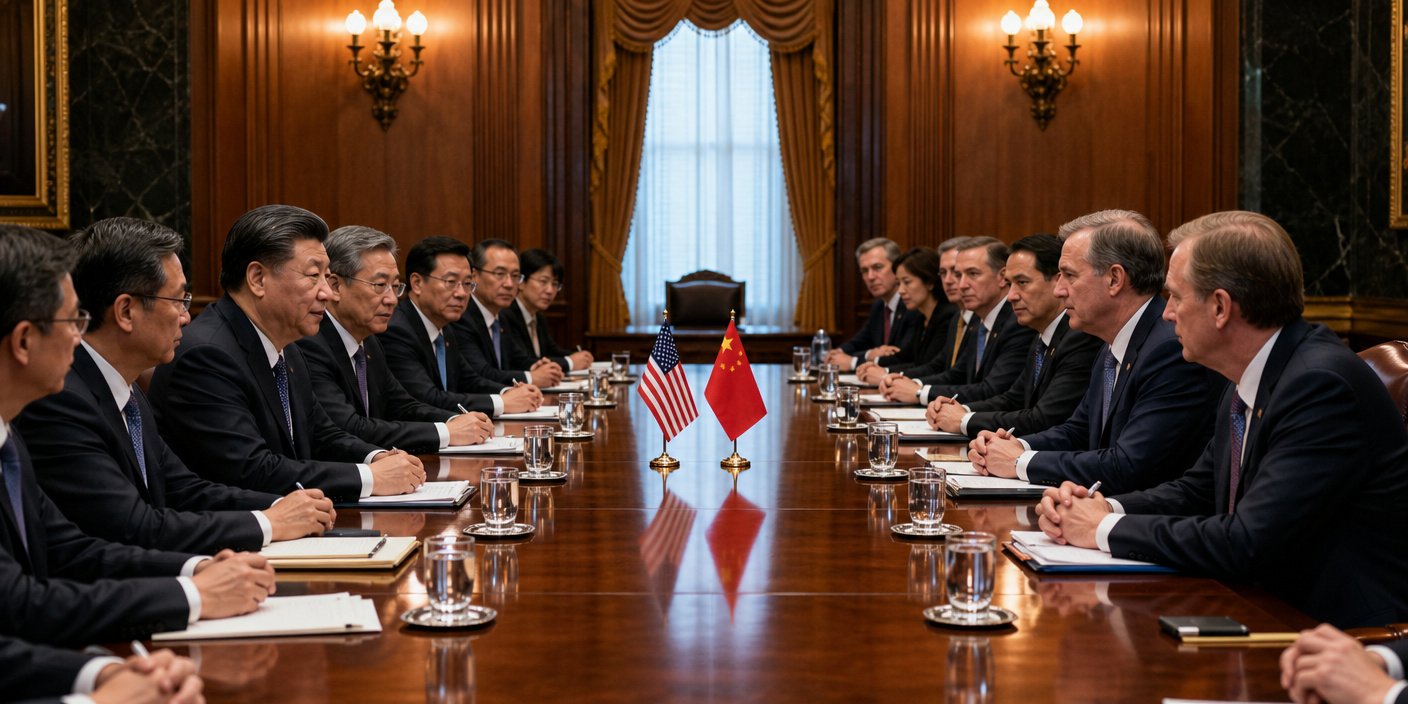
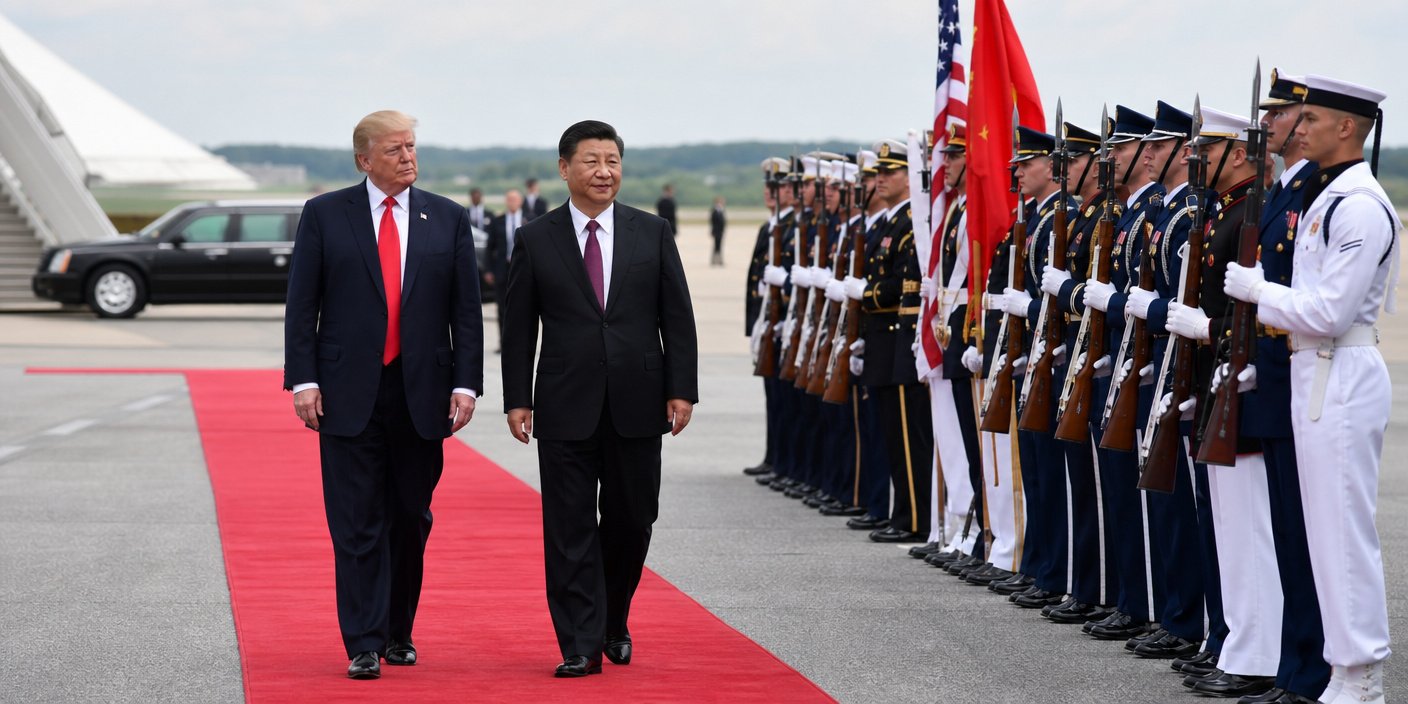
President Donald Trump and President Xi Jinping have secured a critical two-month extension to the ongoing trade truce, a move aimed at stabilizing volatility in global financial markets. The high-stakes diplomatic encounter took place at Joint Base Andrews, where President Trump orchestrated an elaborate reception marked by a 100ft red carpet and full military honors, underscoring the gravity and formality afforded to the Chinese delegation.
Key Highlights
- Formal Reception: The summit featured a 100ft red carpet arrival ceremony with full military honors at Joint Base Andrews.
- Trade Truce Extended: A two-month extension was finalized, preventing immediate escalation in tariffs between the two nations.
- Stability Focus: Both leaders emphasized a desire to temper market volatility, focusing on economic predictability over immediate confrontation.
- Strategic Timing: The agreement provides a 60-day window for further high-level negotiations, shifting the focus from immediate disputes to long-term structural talks.
The Diplomatic Pivot: Calibrating US-China Economic Tensions
The decision to host President Xi at Joint Base Andrews—rather than the traditional White House setting—served as a profound signal of the administration’s intent to marry military-grade respect with commercial pragmatism. By utilizing the base, the Trump administration created a stage that prioritized a grand, orderly arrival, signaling to international observers that despite deep-seated trade disagreements, the structural relationship remains grounded in mutual, if tense, necessity.
The Symbolism of the 100ft Carpet
Visuals at the summit were deliberate. The deployment of a 100ft red carpet serves as a potent diplomatic shorthand; it is a gesture of significant esteem, suggesting that the administration is prepared to offer high-level respect in exchange for actionable economic concessions. For the business sector, which has been rattled by months of uncertainty, the spectacle was intended to convey that the US and China are actively managing their differences rather than allowing them to spiral into unchecked geopolitical instability. The military honors surrounding the event were not merely decorative; they reinforced the reality that trade is now firmly tethered to national security and global power dynamics.
The Economic Calculus of the Two-Month Extension
The two-month extension is the centerpiece of this summit. While trade skeptics might view the delay as a mere “kicking the can” maneuver, the administration posits it as a “stability pause.” This 60-day window is critical for the United States Trade Representative (USTR) and the Chinese Ministry of Commerce to bridge gaps in areas such as intellectual property rights, forced technology transfer, and agricultural purchase commitments.
By securing this window, the US effectively puts a floor under domestic and international markets, preventing the shockwaves of sudden tariff hikes that have previously caused heavy losses on Wall Street and Asian exchanges. This timeframe allows corporate entities—from tech giants to agricultural exporters—to calibrate their supply chains with a higher degree of certainty, assuming the truce holds. However, this stability is fragile; the clock is now ticking on whether these 60 days will produce a binding agreement or simply delay an inevitable escalation.
Behind the Protocol: A Shift in Negotiating Strategy
The change in venue to Joint Base Andrews highlights a pivot in negotiating strategy. Traditionally, summits occurring at the White House are treated as state visits with a heavy domestic press focus. By moving the encounter to a military base, the optics shift: this is no longer just about political branding; it is about the mechanics of power. The exclusion of the typical “White House press pool” atmosphere allows for a more controlled, focused environment where the technical details of the trade truce could be finalized without the immediate performative pressures of Washington’s internal political cycle.
This is a calculated, utilitarian approach. President Trump’s emphasis on “Stability First” suggests an acknowledgment that the American economy requires a cooling-off period. By forcing the Chinese side to engage in a formal, military-honored reception, the US has signaled that it is dealing with a sovereign equal, thereby increasing the political capital needed for Xi Jinping to return to Beijing with a concessions-heavy deal that doesn’t appear like a capitulation.
The Path Forward: Defining the 60-Day Window
The next two months will be dominated by intense, back-channel negotiations. Observers should watch for movement in three key areas: enforcement mechanisms for intellectual property, the removal of non-tariff barriers, and specific purchase quotas for US agricultural goods. If these 60 days are used purely for photo-ops, the markets will likely react negatively upon expiration. If, however, they are used to finalize the structural changes the US demands, this summit at Joint Base Andrews may be remembered as the moment the trade war moved from a strategy of disruption to a strategy of managed realignment.
FAQ: People Also Ask
Q: Why was Joint Base Andrews chosen instead of the White House?
A: The use of Joint Base Andrews allowed for a specialized, secure environment that emphasized military protocol and order, signaling to the Chinese delegation that the US takes the negotiations seriously while bypassing the typical circus of a Washington D.C. state visit.
Q: What does the ‘two-month extension’ actually mean for US companies?
A: It provides a 60-day reprieve from new tariffs. For US companies, this means temporary relief from supply chain disruptions and import cost spikes, allowing for a clearer financial outlook through the end of the current quarter.
Q: How does this impact the ongoing trade negotiations?
A: It creates a concrete deadline. By establishing a fixed two-month window, both sides are under increased pressure to deliver substantive, enforceable commitments before the truce expires, replacing open-ended threats with a high-stakes timeline.