
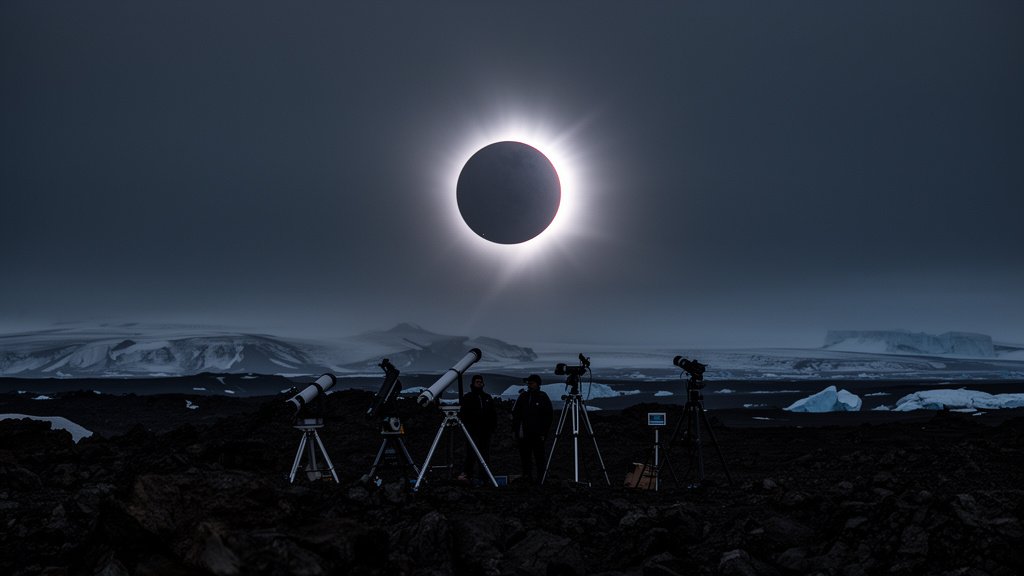
On August 12, 2026, the Northern Hemisphere will witness a significant celestial convergence as a total solar eclipse traces a path of totality across Greenland, Iceland, and Northern Spain. This rare astronomical event marks the first time in decades that a total eclipse will traverse such a significant portion of European territory, offering both professional astronomers and casual stargazers a once-in-a-lifetime opportunity to observe the sun’s corona under optimal conditions. The event, which has already sparked massive interest in travel and scientific sectors, represents a peak moment for European astrotourism.
Key Highlights
- Date of Event: The total solar eclipse will occur on August 12, 2026.
- Path of Totality: The moon’s shadow will traverse the Arctic, specifically crossing Greenland and Iceland, before reaching northern Spain.
- Scientific Significance: The duration of totality will allow for high-precision studies of the solar corona, magnetic fields, and atmospheric responses.
- Preparation Requirements: Observers must utilize ISO 12312-2 certified eclipse glasses at all times during the partial phases to prevent permanent eye damage.
The Celestial Mechanics of the 2026 Event
The 2026 solar eclipse is not merely a tourist attraction but a major data-gathering opportunity for the global scientific community. A solar eclipse occurs when the moon passes directly between the Earth and the Sun, casting its umbra—the darkest part of its shadow—onto a specific, narrow track on Earth’s surface. For the August 2026 event, this track is particularly notable because of its high-latitude trajectory, which presents unique observation challenges and opportunities.
The Geographic Trajectory
The path of totality will begin in the Arctic, making its first significant landfall in Greenland, where remote research stations will be strategically positioned to capture data free from industrial light pollution. Following its passage through Greenland, the shadow will sweep across the North Atlantic and strike the coast of Iceland. This segment of the path is expected to be a global hub for eclipse chasers, as it offers a dramatic backdrop of glaciers and volcanic landscapes. Finally, the eclipse will reach northern Spain, where the sun will be lower on the horizon during the late afternoon. This late-day positioning provides a unique photographic opportunity, allowing for the capture of the eclipsed sun against terrestrial landmarks.
The Science of the Corona
During the minutes of totality, the moon effectively blocks the sun’s photosphere, allowing the solar corona—the sun’s outer atmosphere—to become visible to the naked eye. This region is significantly hotter than the surface and remains one of the most complex mysteries in solar physics. By utilizing the 2026 eclipse, researchers aim to analyze the corona’s magnetic structure and the solar wind, which have profound implications for space weather forecasting. Understanding these phenomena is critical for protecting the global power grid and satellite communications from solar flares.
The Emerging ‘Eclipse Economy’
The upcoming event is already driving substantial economic activity across the path of totality. In Iceland and Spain, tourism sectors are bracing for an unprecedented influx of visitors. This phenomenon, often referred to as the ‘Eclipse Economy,’ involves surging demand for local lodging, specialized scientific expeditions, and travel infrastructure. Local governments in northern Spain are currently coordinating logistics to accommodate thousands of international visitors, focusing on traffic management and public safety in rural areas that may not typically handle high tourism volume.
Beyond tourism, the event has spurred a boom in the optics and photography industry. There is a documented surge in the purchase of solar filters, telephoto lenses, and specialized cameras. Manufacturers of ISO 12312-2 certified eclipse glasses have reported early supply chain preparations to ensure that the massive demand from Europe does not outstrip availability, emphasizing the critical importance of safety protocols for all participants.
Historical Context and Future Predictions
Historically, solar eclipses were often viewed with trepidation, but modern society views them as key educational and scientific milestones. The last significant European total solar eclipse occurred in 1999, which left a lasting cultural impact. The 2026 event is arguably more significant in terms of its reach into high-latitude regions, providing a broader base for international collaboration. Predicting future paths of totality has become highly accurate due to advanced orbital mechanics, and astronomers are already utilizing these models to determine optimal viewing spots. This level of planning distinguishes the 2026 eclipse from historical events, transforming it from a random occurrence into a globally orchestrated scientific endeavor.
FAQ: People Also Ask
1. What is the path of totality for the 2026 eclipse?
The path begins in the Arctic, crossing Greenland and Iceland, before ending in northern Spain during the late afternoon.
2. Is it safe to watch the eclipse without protection?
No. You must use ISO 12312-2 certified eclipse glasses at all times during the partial phases. You may only look directly at the sun with the naked eye during the brief period of total totality, when the sun is completely blocked by the moon.
3. How long will the 2026 total solar eclipse last?
The maximum duration of totality for the 2026 eclipse is expected to be approximately 2 minutes and 18 seconds, depending on your specific observation location along the central line of the path.
4. Why is the 2026 eclipse important for scientists?
It provides a rare opportunity to observe the solar corona’s magnetic field and solar wind dynamics, which are essential for improving space weather prediction models that protect our satellite infrastructure.