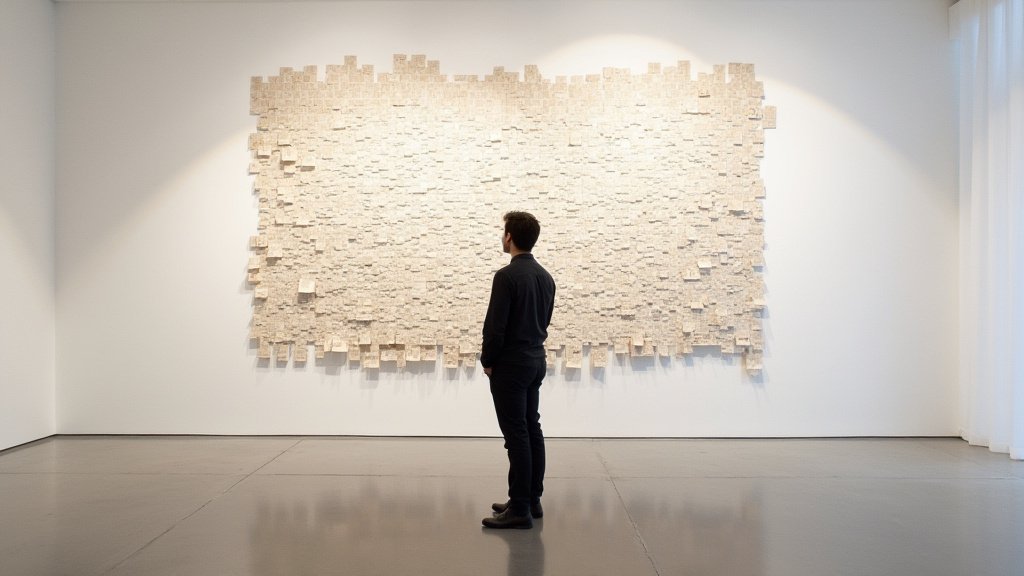
Artist Brejenn Allen has inadvertently become the face of a mounting cultural critique regarding the landscape of modern rural America. Her viral painting, titled ‘Dolla Gentral,’ utilizes an unconventional medium—actual Dollar General receipts—to render a visual manifestation of corporate saturation. The artwork has struck a nerve with audiences nationwide, transcending the gallery space to become a touchstone for discussions on the socioeconomic fragility of rural communities and the rapid proliferation of big-box discount retailers in areas once defined by independent commerce.
Key Highlights
- Medium as Message: Brejenn Allen’s ‘Dolla Gentral’ incorporates genuine store receipts, turning the mundane proof of purchase into a critique of consumer dependence.
- Corporate Saturation: The viral conversation focuses on the rapid expansion of discount retail chains (specifically Dollar General) in rural counties, often coinciding with the disappearance of local grocery stores.
- Food Desert Crisis: The artwork highlights the ongoing debate regarding ‘food deserts,’ where access to fresh, nutritious food is often replaced by shelf-stable, calorie-dense alternatives available at discount retailers.
- Rural Socioeconomic Shift: The piece serves as a physical representation of how corporate convenience models alter the economic ecosystem of small towns.
The Anatomy of a Viral Critique
Brejenn Allen’s work did not just capture a trend; it captured a grievance. By constructing ‘Dolla Gentral’ using actual receipts, Allen transformed the ephemeral data of a transaction—time, price, inventory item, location—into a permanent historical document. The painting forces the viewer to confront the mechanics of the ‘Dollar General economy,’ a model where, in many rural pockets of the United States, these stores serve as the only viable source for groceries, household goods, and toiletries within a reasonable driving radius.
The Mechanics of the Saturation Strategy
Industry data supports the concerns raised by the dialogue surrounding Allen’s work. Major discount retailers have aggressively targeted rural and low-income demographics over the last decade. Unlike traditional big-box retailers that require high population density, these discount models operate on a ‘small-box’ footprint, allowing them to penetrate sparsely populated areas. This strategy has resulted in a massive footprint, with Dollar General alone operating over 20,000 locations as of recent reporting. For many rural residents, the proliferation of these stores represents a double-edged sword: the benefit of low-cost convenience is frequently balanced against the erosion of local tax bases, the closure of independent grocers, and a decrease in the availability of fresh produce.
Mapping the ‘Food Desert’ Reality
One of the primary thematic angles of the discourse surrounding ‘Dolla Gentral’ is the nutrition crisis. Sociologists and rural economists have long studied the correlation between the density of discount retail and the health outcomes of rural populations. When a community loses its primary grocery store—often unable to compete with the price points and distribution efficiency of a national discount chain—residents are left with a ‘convenience’ model. This often involves a reliance on processed, pre-packaged, and frozen goods. Allen’s artistic choice to highlight the receipt—the very itemized list of what a community is consuming—serves as a brutal audit of this dietary shift.
The Economic and Cultural Ripple Effects
Beyond the art itself, the viral nature of this conversation reveals a profound anxiety about rural identity. Small towns have historically relied on a ‘Main Street’ ecosystem where locally owned businesses circulate capital within the community. When a national retail chain becomes the primary economic anchor, that capital is extracted rather than recirculated.
The Decline of Independent Retail
‘Dolla Gentral’ serves as a monument to the vanishing local grocer. As these chains expand, the market barriers for independent stores increase. The conversation surrounding Allen’s work highlights the sentiment that rural America is undergoing a transformation from a community of proprietors to a community of consumers. The painting acts as a mirror, reflecting a reality where the only accessible retail space is one that prioritizes shelf-stable inventory over the nutritional and economic health of the town it inhabits.
Future Implications for Rural Development
As this conversation continues, it is likely to influence policy discussions regarding land use, zoning, and rural development grants. There is a growing movement advocating for urban planning that prioritizes the health of small-town cores. Whether this viral moment leads to tangible change remains to be seen, but it has undoubtedly cemented the ‘dollar store’ debate as a legitimate pillar of socioeconomic analysis in the 2020s.
FAQ: People Also Ask
Q: What is the primary inspiration behind Brejenn Allen’s ‘Dolla Gentral’?
A: The painting is inspired by the observation of rural landscape changes and the ubiquity of discount retailers in small communities, specifically focusing on how these stores have become central hubs for goods at the expense of independent grocers.
Q: Why are store receipts used as the medium in this painting?
A: The receipts serve as both a literal and metaphorical medium. They provide the physical ‘texture’ of the piece while acting as a record of consumer transactions, emphasizing the mundane, recurring nature of the reliance on these retail chains.
Q: Is ‘Dolla Gentral’ considered a political statement?
A: While primarily an artistic expression, the work functions as a commentary on rural socioeconomics, including corporate expansion, food deserts, and the health impacts of modern retail dominance, which has naturally invited political and sociological analysis.
Q: Has the painting led to any changes in local policy?
A: While the painting has sparked a massive national conversation, it has not yet directly triggered formal policy changes; however, it has successfully raised public awareness regarding the impact of ‘dollar store’ saturation on local economies.